

Emptying My Pockets
On being Jewish, Israeli-American, and the rupture of betrayal

I have been going back and forth about writing this.
This is not what I usually write about, and I am filled with anger, hurt, and fear about what pressing send might mean. The atmosphere around anything Jewish or Israeli right now feels so extreme and volatile that even calm, measured discussion feels dangerous and like I’m putting a target on my back.
For months, I have replayed these arguments in my head, turning them over from every angle, trying to understand what exactly has happened these past few years. I have written dozens of drafts and left countless texts unsent. Every time I got close to publishing this (or something like this), I convinced myself it was better to stay quiet than to invite the stress, backlash, and hostility that now seem inevitable.
But this past week felt like a breaking point. I cannot hold this in anymore. If I do not say what I believe and what I know to be true, I will carry this anger and grief around unresolved indefinitely.
So here it is.
I feel deeply heartbroken by the rabid antisemitism and anti-Israel extremism that have taken hold among many progressive people I once considered dear friends. I feel the left has become consumed by an ideological framework that flattens complexity into simplistic moral binaries completely disconnected from history and lived reality.
And in the process, people like me and my family have been turned into the enemy.
I have always considered myself liberal and progressive. I volunteered for Democratic campaigns, registered voters, attended marches and protests, and taught my students to be loving, inclusive, and accepting of all people. I genuinely believed I was part of communities grounded in empathy, nuance, justice, and human dignity.
And yet after October 7, I watched many of those same people embrace distortions, misinformation, and deeply dehumanizing narratives about Jews and Israel.
I watched words like colonizer, oppressor, apartheid, white settler, and genocidal baby-killers used with absolute moral certainty, despite the fact that these frameworks do not accurately reflect the history of the region, the land, the conflict, or the Jewish people.
I watched dishonest memes, decontextualized videos, and misleading graphics spread at astonishing speed, amplified by people speaking smugly but ignorantly about a history, a land, and a people they do not know firsthand and whose consequences they will never have to live with.
It has been disorienting, confusing, infuriating, and so utterly painful.
But even more painful than the misinformation has been the silence.
Many of my progressive, justice-minded friends never checked in on me or my family during the massive rise in antisemitism after October 7. They never checked in as bombs flew over my family’s heads and relatives spent days running to bomb shelters under rocket fire.
People who know me. People who know my family.
That silence has felt like a profound betrayal.
And that betrayal is part of why I feel compelled to tell my story now.
*
I am half Israeli. My father was born there in 1952. His parents, my grandparents, arrived in Israel in the 1940s after being forced to flee Baghdad, Iraq.
We are Mizrahi Jews, descended from Jewish communities that remained in the Middle East and North Africa after ancient exiles such as the Assyrian and Babylonian conquests.


I would guess many people reading this have never heard that term before. Most conversations about Jewish history focus almost entirely on Ashkenazi Jews, Europe, and the Holocaust. But for thousands of years, Jewish communities also existed across the Arab world, in Iraq, Yemen, Egypt, Libya, Morocco, Syria, Iran, and beyond. Mizrahi Jews represent some of the oldest continuous Jewish diaspora communities in the world.
My family came from Baghdad, which once held one of the oldest and largest Jewish communities in the world. Jews had lived there continuously since the Babylonian exile.
Then, within a single generation, those ancient communities were completely decimated.
Persecution, violence, confiscated property, and expulsions drove roughly 850,000 Jews out of countries across the Middle East and North Africa in the mid-twentieth century.
My grandmother, Shulamit, walked across miles of desert under cover of night to escape violence and persecution. My grandfather, Victor, was humiliated, stripped of his belongings, and forced to surrender his Iraqi citizenship during Operation Ezra and Nehemiah, when more than 120,000 Iraqi Jews were airlifted from Baghdad to the newly formed State of Israel.
They did not arrive as conquerors or colonizers. They arrived because they had been expelled from the countries their families had lived in for centuries.
They arrived with nothing except the clothes on their back and a deep historical and spiritual connection to the land.
Because they went to Israel for a reason.
Not because it was some arbitrary political project dropped onto a map, but because the Land of Israel has been central to Jewish identity, religion, and history for thousands of years.
Jewish holidays revolve around the land’s agricultural seasons and geography. Jewish prayers have faced toward Jerusalem for millennia. Jewish presence in the land has been continuous for thousands of years.
For Jews fleeing persecution across both Europe and the Arab world, Israel was not a random foreign place. It is the Jewish ancestral homeland.
That entire layer of history, that Jews are indigenous to the land and not foreign colonizers, is almost completely absent from the way I see Israel discussed today. Additionally, the history of Mizrahi Jews like my family — who make up at least 60% of modern Israeli society — is also almost never mentioned in these conversations.
There is no other place my family can “go back” to if Israel is erased “from the river to the sea.” There are literally no Jews left in Baghdad. There is no “right to return” for my family.
That reality feels completely absent from the conversation.
*
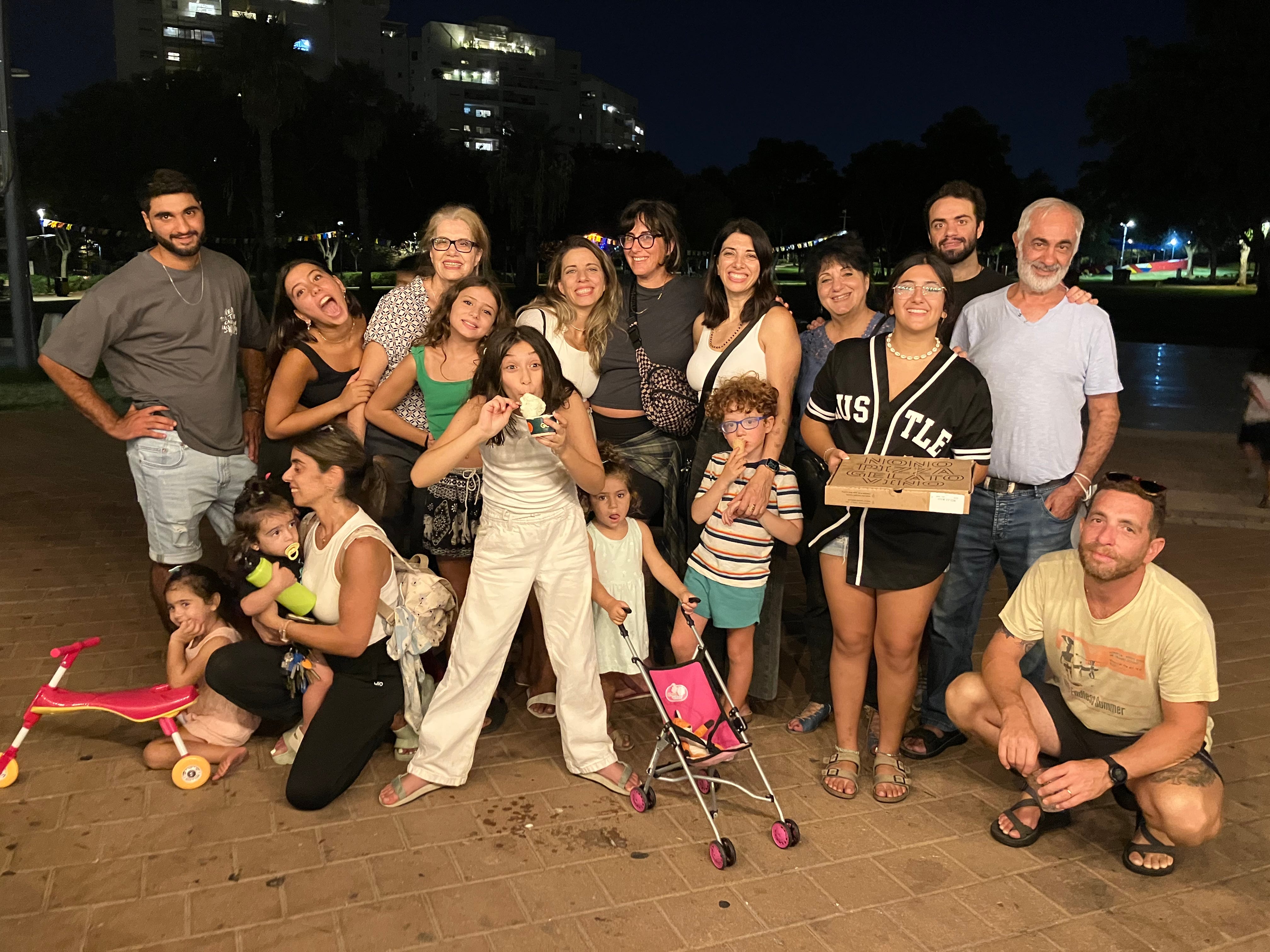
My grandparents arrived in Israel as refugees with absolutely nothing to their name. Like so many Jewish families who came from Europe, the Middle East, and North Africa, they did what people do after rupture: they rebuilt. They made a life where there had been none.
That life became my family.
Israel, to me, is not an abstraction or a political slogan. It is the place where my father was born and still lives, the place where my cousins grew up, and the place I have visited for weeks and months at a time. It is where my relatives gather for loud Shabbat dinners, argue endlessly about politics, complain about traffic, go to the beach, build careers, raise children, fall in love, and try to live ordinary lives in an extraordinarily complicated region.
It is a real place filled with real people, not props in someone else’s morality play.
Israel itself is vibrant, diverse, and layered. Jews whose families came from Iraq, Morocco, Yemen, Poland, Ethiopia, Iran, Argentina, Russia, and many other places now live alongside Muslims, Christians, Druze, and others in a country roughly the size of New Jersey.
Yes, New Jersey. It really is that small. You can drive from one end to the other in about six hours, which is part of why the scale and intensity of global obsession with it can feel so surreal—and so pointed.
It is also imperfect, like every country on earth. Israelis argue about everything. Spend five minutes at my family’s Shabbat table and you will hear debates about government, religion, security, borders, war, peace, and the future of the country. Arguing is practically a national pastime.
Criticizing a government is normal. Necessary, even. Israelis do it constantly. There are decisions that the Israeli government makes that are wrongheaded, reckless, or harmful, just as in any other country.
But much of the global conversation feels fundamentally different from criticism of policy or leadership.
Israel itself is increasingly spoken about as uniquely evil, uniquely illegitimate, and uniquely deserving of outrage in a world filled with brutal wars, occupations, dictatorships, ethnic conflicts, and humanitarian crises.
It is spoken about with a hyper-focus level of moral certainty and simplicity that rarely exists anywhere else in international politics. And when your family, your history, and your loved ones are bound up in that place, that certainty lands differently.
It becomes disorienting.
And it becomes personal.
*
The Israeli-Palestinian conflict is one of the most painful, complicated, and enduring conflicts in the modern world. Entire libraries have been written about its history, wars, failed peace negotiations, terrorism, displacement, borders, religion, nationalism, and competing narratives of belonging and survival.
I could spend pages walking through every historical argument and counterargument. I could dissect timelines, negotiations, intifadas, ceasefires, and competing claims to the land.
But that is not actually the center of what I need to say.
Because whatever someone believes about the conflict, something profound shifted after October 7.
Over 1,200 people were murdered. Families were burned alive in their homes. Young people were hunted down at a music festival. Women were raped and mutilated. Children and grandparents were kidnapped and dragged into Gaza.
It was the largest massacre of Jews since the Holocaust.
And what has haunted me almost as much as the brutality itself was how quickly so many people seemed ready to explain it away, contextualize it, or fold it immediately into an abstract political narrative.
Before bodies were even identified, before families knew whether their loved ones were alive or dead, the conversation in many progressive spaces had already shifted almost entirely to Israel’s response. It blamed Israel for the attack itself.
The massacre itself disappeared into fancy political language about “resistance,” “decolonization,” and “by any means necessary.”
I watched people who would normally speak with enormous sensitivity about violence suddenly become strangely detached when Jews were the victims.
Their grief felt conditional.
Their horror came with caveats.
Their empathy arrived already filtered through ideology.
If the grief, horror, or empathy even arrived at all.
*
And then, immediately under the shadow of that suffering, came the flood of accusations.
I keep coming back to something Jean-Paul Sartre wrote, in 1946:
“The anti-Semite doesn’t accuse the Jew of stealing because he actually believes he stole. He accuses the Jew of stealing because he enjoys watching the Jew empty his pockets to prove his innocence.”
That is what this period has felt like for many Jews, myself included: documented atrocities against Jews denied, dismissed, or rationalized, while sensational and dehumanizing accusations against Jews spread at neck-breaking speed, often used to justify why we are hated, attacked, or blamed in the first place.
Words are stripped of their context and then redeployed onto us as accusations. Terms like Zionist or genocide are pulled out of their history, flattened, and placed back onto Jews as things we are expected to defend ourselves against, even when they do not reflect what we believe, what the words actually mean, or what is actually happening.
Rumors, distortions, and extreme claims spread with extraordinary speed when directed at Jews or Israel. And no matter how absurd the accusation, we are expected to engage with it seriously in order to prove our humanity, our nuance, our right to complexity.
And even when every answer is given carefully, historically, factually, it does not end the cycle.
It just resets it.
A new accusation appears. A new double standard emerges. A new demand for explanation takes its place.
And part of what has become so exhausting is that I can feel myself still wanting to participate in it all anyway. I still want to empty my pockets for you. I still want to believe that if I just explain my family and our history and the Jewish people well enough, carefully enough, patiently enough, something might finally land and open people’s minds.
As if telling people my family fled Iraq will make the label “white colonizer” disappear.
As if describing the millions of Muslims, Christians, Druze, and Jews living inside Israel will suddenly complicate the word apartheid.
As if reminding people that October 7 was the largest mass murder of Jews since the Holocaust will make them understand why Jews and Israelis experienced it as an overwhelming existential trauma.
As if explaining that Hamas deliberately embeds military infrastructure within civilian areas while its leadership shelters underground, leaving civilians aboveground unprotected, would make people more cautious about throwing around important language like genocide.
As if pointing to the many misreported stories, decontextualized (or straight-up manufactured) video clips, and explosive headlines later corrected or quietly retracted would undo narratives that had already taken hold.
But eventually I began realizing that much of this conversation was not actually about missing information.
The point is actually the endless requirement to perform our innocence in the face of accusation.
The moral framework itself had already been decided.
According to this worldview, the world is neatly divided into oppressor and oppressed, colonizer and colonized, good and evil. And once Jews and Israel were placed into the category of oppressor, every fact, history, or complexity that complicates the narrative becomes irrelevant.
No amount of context, historical detail, personal story, or competing perspective can meaningfully change the outcome.
That is part of why so many Jews increasingly feel that something deeper than ordinary political criticism is happening.
Because across history, antisemitism has always adapted itself to the moral language of the time.
Jews have been portrayed as both pathetically weak and dangerously powerful, as rootless outsiders and manipulative puppet masters, as capitalist exploiters and communist infiltrators, sometimes simultaneously.
The accusations change shape depending on what a society most needs to fear or externalize.
Today, in many progressive spaces, Jews and Israel have become a screen onto which people project colonial guilt, racial anxiety, and broader anger about Western power. “Antizionism” has become the contemporary vocabulary that holds an older and more enduring hatred.
The language has changed.
The pattern feels painfully familiar.
*
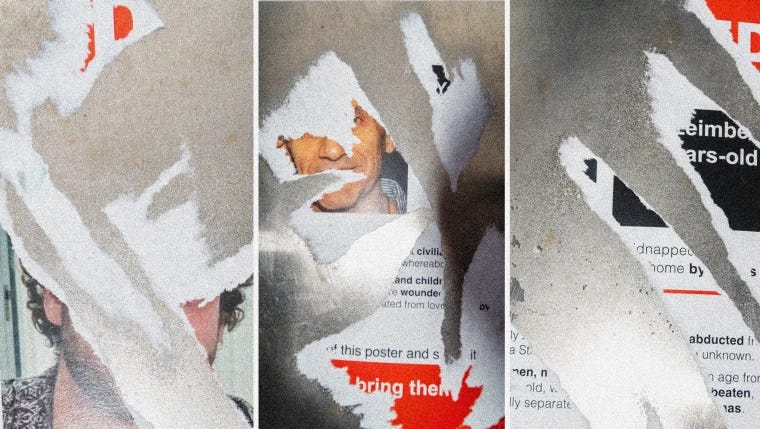
This was not abstraction for me or my family. It hit extremely close to home.
I wrote previously about us leaving Brooklyn, but at the time I was not ready to fully name one of the reasons: the antisemitism that began spreading through our neighborhood in the weeks and months after October 7.
It felt like something shifted overnight.
Every stop sign had some sort of “Fuck Israel / Free Palestine” sticker. Posters of the hostages were gleefully ripped down less than a mile from our home. Bookstores and shop windows displayed blatantly one-sided political messaging.
Marches and protests became constant. On the streets where we lived our daily lives, slogans like “Globalize the Intifada” and “From the river to the sea” and “by any means necessary” surrounded us. Outside my child’s school, outside his playground, outside our farmers market, weekly gatherings formed where those chants were repeated with a kind of absolute certainty and angry urgency that was impossible to ignore.
What struck me was not disagreement. People can disagree about politics.
It was the sense that something intensely politically one-sided had entered spaces that were supposed to feel safe for all children and families.
These were not calls for peace or coexistence. They were calls to erase Israel from the map and to globalize violence against Jews.
I began changing how we moved through the neighborhood. I became careful about what I said, what I revealed, what I allowed to be visible.
At my child’s school, there was a culture day. I did not feel safe sending him with Israeli hummus or falafel, even though that is what I would have once done without hesitation (and what I once brought in myself, proudly, in elementary school). I could not, in good conscience, identify him that way in that environment. So I sent him with babka instead, something more neutral, something that would not mark him too clearly.
I never thought I would be making decisions like that in a place like Brooklyn.
We even made a dark joke about it at home that some ancient epigenetic nerve had been triggered.
My mother’s father leaving Poland for safety. My father’s parents forced out of Iraq. My husband’s family fleeing pogroms in Europe.
Jews have a long memory of what it feels like when the atmosphere of a place shifts.
It was not only political disagreement. It became something more bodily, more ancestral, a recognition I could not fully rationalize but also could not ignore.
We left.
And in that decision I felt something I recognize from my own family history: generations of Jewish families moving again and again in search of safety.
I did not plan to be part of that pattern. I never thought I would have to be. And yet, in that moment, I understood it in a way I had never understood before.
*
This week’s release of the Civil Commission investigation into October 7 deepened this heartbreak for me all over again. The report documented, in devastating detail, the brutality of the attacks: sexual violence, torture, executions, kidnappings, and the deliberate targeting of civilians.
Much of the evidence came directly from Hamas themselves through videos and photographs recorded on GoPros and phones and proudly shared online during the massacre.
And yet I know many of the same people who spent the last two and a half years instantly believing and amplifying the most extreme accusations about Israel will never seriously engage with that report at all.
That asymmetry is impossible for me to ignore.
For years, I believed deeply in progressive spaces and feminist movements that emphasized believing victims, honoring lived experience, and taking violence against women seriously.
After October 7, I watched many of those same spaces suddenly become hesitant, evasive, or outright dismissive when the victims were Jewish and Israeli women.
Even though the crimes were heavily documented and widely circulated by the perpetrators themselves, the victims were still not believed.
And if they were believed, they were blamed for it.
That realization has been one of the most painful parts of all of this.
At the same time, I want to be clear about something that also gets flattened in these conversations.
I care about Palestinian life and dignity. I do not believe Palestinian civilians should be stripped of their humanity any more than Israelis should. I want Palestinians to live in safety, freedom, and peace, without fear, violence, corruption, extremism, or endless war.
But I also do not view Hamas as a liberatory movement. Absolutely not. I see them as a violent terror organization whose extremist ideology and actions have brought unbelievable suffering to both Israelis and Palestinians alike.
And I believe that clarity matters. Because when Hamas governs through violence, intimidation, and opressive authoritarian control, it is ordinary Palestinians who bear the cost most directly.
To care about Palestinian life is also to be honest about what stands in the way of it.
I hold both truths at the same time: compassion for Palestinian suffering, and clarity about the forces that perpetuate it.
*
Alongside everything else this experience has surfaced, I have been surprised and grateful to find a new and growing sense of Jewish pride in myself.
For most of my life, my Jewish identity existed blurry and in the background. It was vaguely cultural more than anything else: food, family, holidays, a certain sense of humor. My family did not go to synagogue. I did not have a bat mitzvah. It always felt a little distant to me, like something adjacent to who I was rather than central to it.
That has changed.
Post October 7, and through the rupture of this past period, I have become newly aware of what Jewish people have carried through history. I feel it in a more visceral way now, including within my own family line. I think of my mother’s father leaving Poland for America and my father’s parents fleeing Iraq for Israel, different worlds shaped by the same pattern of displacement, survival, and the effort to continue living with dignity and continuity.
There are not that many of us in the world, and yet the impact of Jewish people on culture, science, art, literature, medicine, and education is enormous. Jewish life has always been shaped by people who read, question, argue, and learn, and who build thriving communities even under pressure and uncertainty.
I feel proud of that tradition, and I feel proud of the resilience that has carried us through centuries of adversity, as well as the humor that somehow survived alongside it.
I also feel protective of our future.
Raising my boys now, I feel a new sense of purpose and intention about connecting them more deeply to Jewish life and community. Something I once took for granted now feels precious, and I want them to know where they come from in a way that is grounded and real, so they feel both rooted in it and proud of it.
I want to give them not only history, but belonging within that history.
I want to raise them to be good, kind Jewish boys, like any proud Jewish mother would want.
I do not want them defined by what is said about us, or reduced to what is projected onto us, or flattened into someone else’s story, or turned into symbols in someone else’s moral narrative.
I want them grounded in who they actually are, and in the stubborn survival of their people.
I have already seen the fruits of this new Jewish identity and pride take root in my own life. I began working as a family connector this year, organizing meetups at parks and playgrounds for Jewish children and their families.
I also began teaching Hebrew school to 3rd graders at our local synagogue, where I now make a point to say hello and thank you to the armed guard standing outside helping keep our community safe.
That detail alone says more than I wish it did.
The world can feel frightening right now for Jews. History makes clear that there have always been those who wanted us gone.
But despite everything, despite a long and painful and extraordinary history, and despite the noise and volatility of this moment, we are still here.
And I will say this as plainly as I possibly can:
We are not going anywhere.
I haven't read this yet, though I'm about to! I am a Christian married to a Jewish man, and these years since 10/7 have been real eye-openers for me, as I've watched former friends and acquaintances spout hatred that they view as "speaking truth to power." I have had a perpetual anger simmering under the surface, on behalf of my husband and Jewish and Israeli in-laws. Sadly, I know that it took a lot of bravery for you to write this post. Thank you for doing so.
I’m glad you decided to write this essay. Whether or not turning out your pockets changes the minds of our “inquisitors”, it will be read and appreciated by many other Jews, as it was by me.